


Introduction
Frankly speaking, if you attend a proper Igbo traditional wedding, it’s difficult not to feel the “love in the air” especially with plenty of fun activities that happen as part of the ceremony. During my friend’s traditional wedding, I could truly feel it.
My friend looked extremely happy that morning as if she had won ten million Naira from 9jabet. Ijeoma could barely contain her excitement. Her typical joking attitude made it even more overwhelming. I can’t even start counting how many times she happily ran into my room that morning, just to tap me and pull that her typical five-year-old-funny face. You don’t blame her though. Ijeoma, my beautiful friend, had been patiently waiting for this day for what seemed like forever. Tha i’s ever since she and Nzube began their dating. So, at last, it was her “ibu mmanyi” day (also known as “Igba nkwu” day). It’s the term used for an Igbo traditional wedding.

The Igbo culture is quite amazing. And, the Igbo traditional wedding is among the most interesting aspects of their culture. So stay with me here, and I’ll give you a run-down of some interesting things you may need to know about a normal Igbo traditional wedding because I have witnessed a handful of them firsthand.
“Iku aka”: The Formal Introduction between the bride and groom’s family
They usually start this process by setting up a day for an introductory visit called “Iku Aka”, which is literally translated as “knocking on the door”. On that day, official introductions are made between the families of the bride and the groom. This is the first time that the groom’s family “officially” shares their intention to marry the bride to the bride’s family. Though both families probably already knew about it.
As a token of their courtesy and sincerity, the groom’s family usually comes with gifts. A bottle of wine and some kola nuts has got to go with the present too.
The Playful “Knock On The Door” That Sets The Foundation For A Lifelong Union.
This ceremony is done in a fun manner. This is how they usually do it. So, while expressing their intention to the bride’s parents or family, the spokesperson from the groom’s family would say something like:
“The other day, we saw a beautiful flower in your house and we liked the flower. So today, we have come to ask for your permission to pluck it”.
This line is then followed by some further playful “pretentious” inquiry by the bride’s family to know the particular girl they are interested in (even though they already know who they want). The bride-to-be whose name they have now mentioned is then invited to greet the visitors.
The groom’s family then confirms that she’s the one they are interested in. Her father (this could also be any other person who serves as the spokesman for the bride’s family that day) now asked her if she thinks she would want to go along to accept their intention, or if they should end the discussion there. Ijeoma said yes, she was interested in the discussion. She will want to marry the groom. Of course, that’s what every one of them says. Everyone cheered with excitement before she was asked to return to her room.
The short, playful conversations that follow between the elder members of both families will become the beginning of the formal interactions between these families and it’ll establish the tone for the marriage. When the visitors leave, then a list of items needed for the real ime-ego would be given to the groom’s family by the bride’s family a few days or weeks later.

Bargaining of the Bride Price (Ime Ego)
The “Ime Ego” or bride price negotiation comes next. This is an ancient custom but, it is still practiced today in the Igbo culture. On this day, the groom’s family would come to present those items on the list they received to the family of the bride. This ceremony is supposed to be a polite negotiation process where things like wrappers, drinks, kola nuts, yams, etc on the list are exchanged. it is usually exchanged with jokes and some witty talks by the side. Culturally, these gifts are meant to show regard for the custom, the bride’s value, and her people. However, the demands listed are also sometimes negotiable. For example; from the 100 tubers of yam written on the list, you can even negotiate down to 20 tubers, just like that. However, if the groom wants he can decide to do even more than what is on the list. So, It is not supposed to be cast on stones.
The Bride Price and Its Cultural Significance
One interesting thing in this is that despite all the many items listed, the actual bride price is often a small amount of money. In some families, it can be as small as N100, N500, or even N50. The actual bride price is usually the last present to be collected by the bride’s family. It is a symbolic thing that shows that the groom is formally committed to the family of the bride in marriage. Therefore, it is not necessarily considered as a payment of money. Let me just tell you its important significance in Igbo traditional marriage.
Here, is the not-often-mentioned significance of “the bride price” in Igbo culture by the way: No matter what is given or not given, once this little amount of money (the N500 or whatever they agreed on) is paid, and it’s received by the bride’s family as “the bride price”, the deal is sealed: The two are officially husband and wife. The other things done later are formalities. On the other hand, if for any reason the couple wants to end that marriage later (which is even highly discouraged in Igbo culture), the culture also demands that there should be another formal meeting between the two families. Then the family of the bride will have to “willingly” return that particular “bride price”. Also, the groom’s family must willingly collect it back. This would serve as a sign that both families have agreed that the marriage has been dissolved. Let’s now talk about the major highlight of the occasion, the actual “ibu-mmanyi”…
The Bride’s Search For Her Future Husband: The Highlight Of The Wedding Ceremony
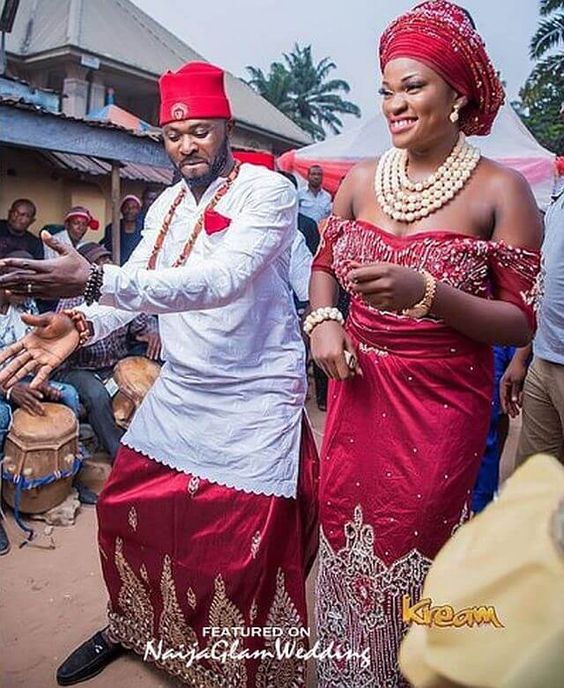
The bride’s father gives her a cup of palm wine to offer her future husband as a way of introducing him. She searches through the crowd of people for her groom while holding this cup of palm wine. She would not offer the wine to anybody else, even though the visitors jokingly interrupted her and asked her to give it to them. To add to the excitement and difficulty of the search, the groom would occasionally even hide among the crowd. When eventually she finds him, she gets to him, kneels before him, and respectfully offers him the cup of wine. This is how she formally reveals the man she has accepted to be her future husband publicly. Then, the groom drinks the wine as a symbol that he also accepts her as his bride. This is the peak of an Igbo traditional wedding. This gesture is celebrated by the guests with cheers of joy. Following that, they both dance to meet her father and get his blessing.
Picture credit: Pinterest
The Igbo Traditional Wedding Attire
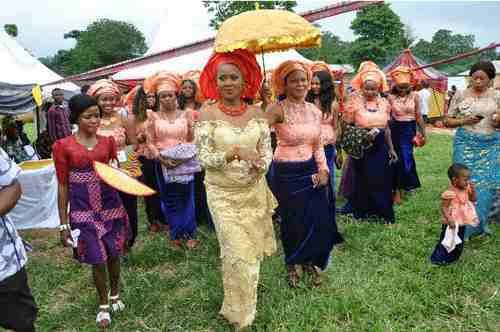
Beautiful cultural fashion displays are an outstanding feature of an Igbo traditional wedding. Typically, the bride puts on a stunning top, George wrapper, with plenty coral beads and other customary jewelry. On the other hand, the groom usually wears a symbolic “Isi-agu” top, a wrapper, and a cap.
We hope you enjoyed this article. Follow us on our blog as we continue to explore the unique traditions that form the core of our communities.